Anand-Carlsen French: Queen Raid Meets Perpetual Check
Stockfish-backed analysis of Anand vs Carlsen's French Winawer battle, from the early queen sortie to the forced perpetual check.

Opening: Winawer tension and an early queen raid
The game began as a French Defense: . Carlsen chose , entering Winawer structure territory and immediately asking whether White would accept doubled c-pawns in return for bishop-pair chances and central space. Stockfish preferred , but the game move was only a small concession: +0.36 became a played-root +0.63, a 27-centipawn loss.
The first major swing came one move later. Anand played , forcing the bishop question, but Stockfish's best was the more direct . After , the game reached a known practical imbalance: White had the bishop pair and a kingside attacking idea, while Black had damaged White's queenside structure and a clear target on c3.
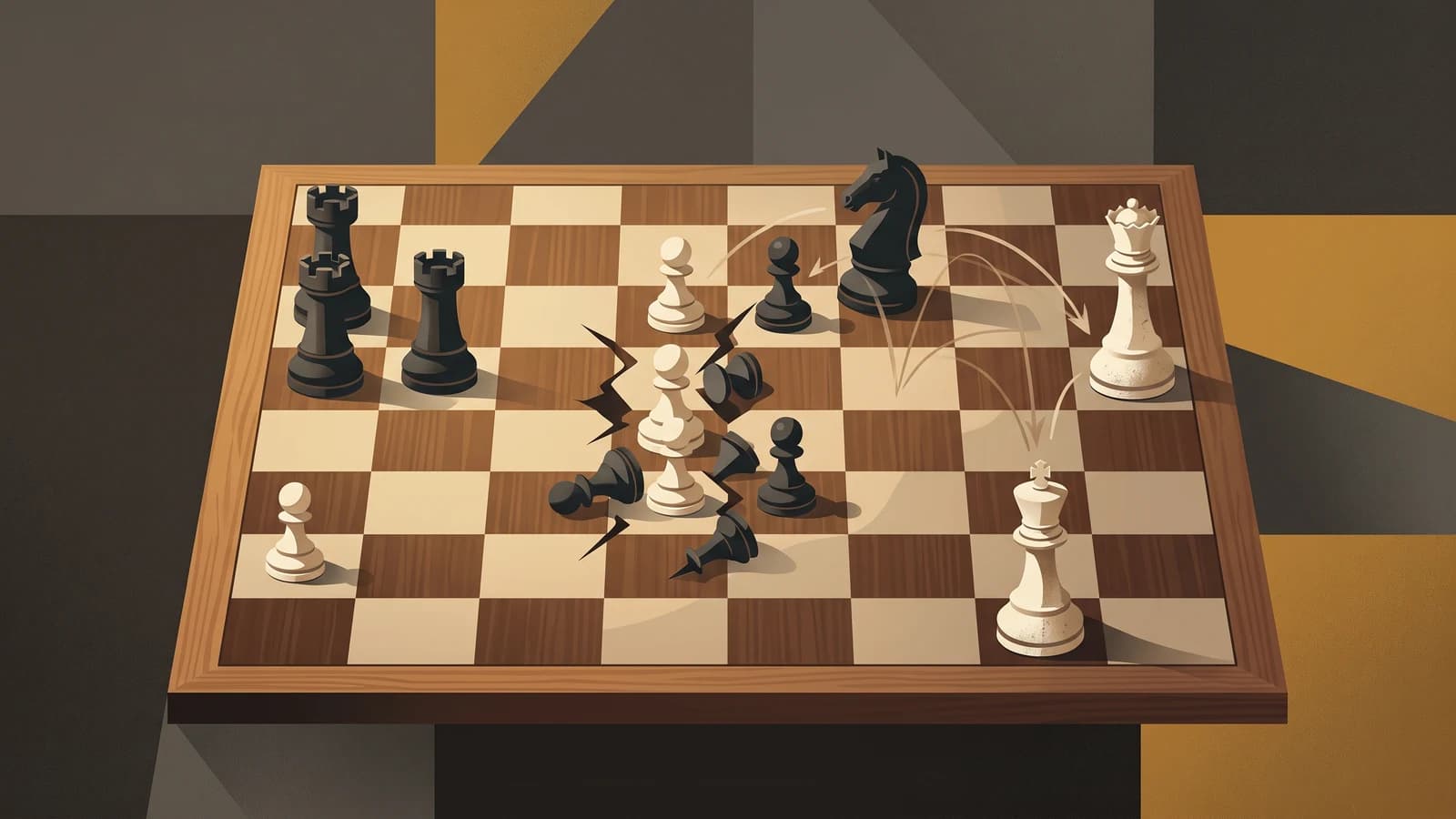
Anand's was precise, and after , the queen had won the g7-pawn but became the central strategic character of the game. Black's compensation was not speculative: rook activity on the g-file, pressure against c3 and c2, and a lead in practical coordination.
Evaluation swing scorecard
| Ply | Move | Player | Eval before | Played-root eval | CPL | Best move |
|---|---|---|---|---|---|---|
| 7 | Viswanathan Anand | +0.79 | -0.20 | 99 | ||
| 18 | Magnus Carlsen | 0.00 | +0.59 | 59 | ||
| 23 | Viswanathan Anand | +1.22 | +0.85 | 37 | ||
| 27 | Viswanathan Anand | +0.89 | 0.00 | 89 |
: forcing the bishop, releasing the center
The move allowed Black to clarify immediately with and then strike with . The concrete point was that White's queenside structure became a long-term target before White had fixed the center with e5. The game continuation left Black active enough for equality.
Stockfish's avoids that version of the problem by taking space first: . Black still gets the Winawer structure, but White's center is more stable and the queen raid is supported by a stronger spatial grip.
Black's missed chance to open the center
After , Black faced a key timing decision. Carlsen played , developing naturally, but Stockfish wanted at once. The issue is move order: by delaying the exchange, Black let White continue with and keep a healthier version of the center.
The best line keeps the queen under observation while attacking the center before White fully coordinates. In the game, still generated pressure, but the evaluation rose to around +0.6 for White.
Carlsen's was consistent with the plan: attack c3, discourage smooth development, and prepare queen-side infiltration. It was not a large engine swing, but it made the tactical map clear.
: grabbing a pawn, loosening the coordination
After , Anand chose . This won time against Black's center but allowed Black's pieces to activate against White's queen and queenside pawns. The concrete response in the played line was , when Black regained the c5-pawn and kept pressure on c2.
Stockfish preferred . The sample line shows the difference: White centralizes the queen, meets the invasion with Rc1, and uses exchanges on e4 and f6 to reduce Black's attacking coordination. In the game, the queen went to f4 only after , and Black's queen soon landed on c2.
: one tempo too slow against the c-file targets
The final major swing was . It developed and prepared castling, but it allowed the direct . The target was simple and concrete: Black invaded on c2, hit White's queenside, and made the bishop on d2 vulnerable to later tactics.
Stockfish's best was , immediately challenging Black's central control and slowing the queen raid: . Black remains active, but White has gained central space and has not handed over c2 so cleanly.
In the game, was still resourceful. Anand found the forcing queen move that held the balance. Carlsen correctly answered , and after , the material and threats had transformed into a tactical race.
Conclusion: perpetual check as the accurate finish
The decisive defensive resource came from Black's rook and knight activity: . Stockfish scores each move in this sequence as best or equal. White cannot improve by hiding on h1 in the critical moments: after , Stockfish gives ; after , .
So the draw was not a quiet fade-out. It was a forced practical conclusion to a game where White's queen raid won material and activity, but Black's queen, rook, and knight created enough direct king pressure to repeat.
Practical lessons
In the Winawer, forcing with a3 is not automatically useful; if White has not fixed the center with e5, Black may get clean counterplay against c3 and c2.
When the opponent's queen is deep in your position, the best compensation is often not a queen chase by itself. Carlsen's key themes were central breaks, rook activity on the g-file, and concrete targets on the c-file.
For White, queen raids work best when the queen has a stable retreat and the center is under control. Stockfish's preferred and both show the same lesson: central coordination mattered more than another pawn or a routine developing move.
For Black, the perpetual check pattern with , , and was the tactical payoff. Once the king was boxed between g1 and g2, repetition became the accurate result.